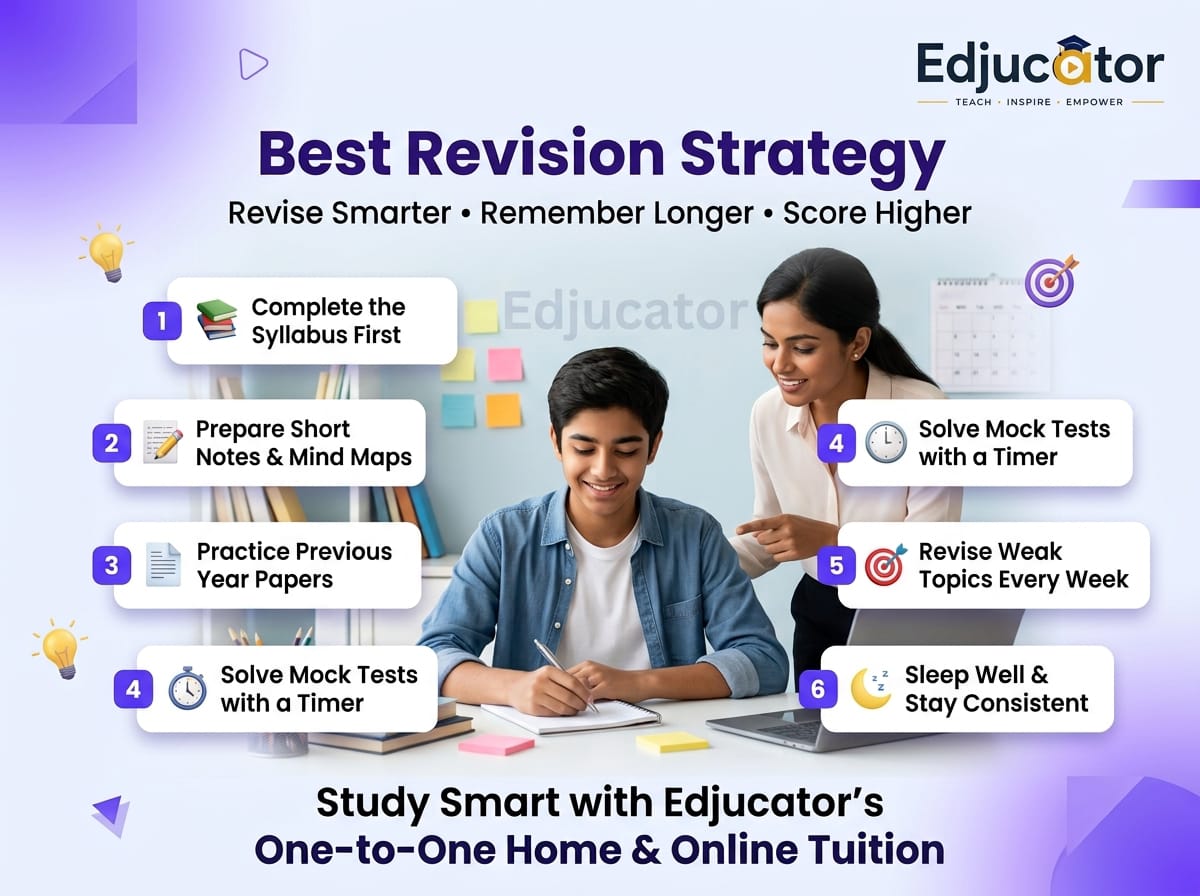
Best Revision Techniques to Score Higher in Exams
Introduction: Revision is one of the most critical aspects of exam preparation. Learning a concept is important, but regular revision helps the information move from short-term memory to long-term memory so that it can be recalled during the examination.
When students spend hours in their study time but fail to remember the basic concepts they learned, they just can’t make good revision. Good revision isn’t about reading textbooks over and over again—well, not if you’re going to do it the right way—it’s about good thinking and good habits of thinking, understanding, retention, and confidence.
Whether you’re in preparation for CBSE, ICSE, State Board, JEE, NEET, CUET, Olympiads, or school exams, these proven revision techniques really do help you study smarter and perform better.
When Should You Start Revising?
One of the biggest mistakes students make is waiting until the last week before exams.
A better strategy is:
- Daily Revision: Review what you learned on the same day.
- Weekly Revision: Revise all topics covered during the week.
- Monthly Revision: Revisit important chapters.
- Final Revision: Focus on formulas, key concepts, and practice papers before exams.
This spaced approach improves long-term retention.
The 10 Best Revision Techniques
1. Active Recall
Instead of reading the same chapter repeatedly, close the book and test yourself.
Ask questions like:
- What are the main points?
- Can I explain this concept without looking?
- Can I solve similar questions?
Active recall is one of the most scientifically proven learning techniques.
2. Spaced Repetition
Revise information at increasing intervals instead of cramming.
A simple schedule:
- Day 1
- Day 3
- Day 7
- Day 15
- Day 30
This technique strengthens long-term memory and reduces forgetting.
3. Practice Previous Year Question Papers
Past papers help you:
- Understand the exam pattern
- Improve speed
- Identify important topics
- Build confidence
Solve them under exam-like conditions.
4. Create Mind Maps
Mind maps connect ideas visually, making complex topics easier to remember.
They’re especially useful for:
- Science
- Biology
- History
- Geography
- Economics
5. Make Short Notes
Prepare concise notes containing:
- Definitions
- Formulas
- Important dates
- Diagrams
- Keywords
Quick notes are ideal for last-minute revision.
6. Use Flashcards
Flashcards work well for memorizing:
- Vocabulary
- Equations
- Scientific terms
- Historical events
- Definitions
Digital apps or handwritten cards are equally effective.
7. Teach Someone Else
Explaining concepts to a friend, sibling, or parent helps identify gaps in your understanding.
If you can teach a topic clearly, you’ve likely mastered it.
8. Solve Mock Tests
Mock tests simulate the actual examination environment.
Benefits include:
- Better time management
- Improved confidence
- Reduced exam fear
- Performance analysis
Aim to complete multiple full-length mock tests before major exams.
9. Follow the Pomodoro Technique
Study in focused intervals:
- 25–30 minutes of study
- 5-minute break
After four sessions, take a longer break.
This keeps your mind fresh and improves concentration.
10. Revise Weak Topics First
Many students spend too much time revising their favorite subjects.
Instead:
- Identify difficult chapters.
- Spend extra time strengthening weak concepts.
- Practice additional questions.
Balanced preparation leads to better overall performance.
Common Revision Mistakes to Avoid
Avoid these common errors:
❌ Starting revision too late
❌ Reading without practicing questions
❌ Ignoring weak subjects
❌ Memorizing instead of understanding
❌ Studying for hours without breaks
❌ Skipping previous year papers
❌ Not reviewing mistakes made in mock tests
Sample Revision Timetable
| Time | Activity |
|---|---|
| 6:00–7:00 AM | Revise previous day’s lessons |
| 4:00–5:00 PM | Practice questions |
| 5:15–6:00 PM | Revise difficult topics |
| 7:00–8:00 PM | Mock test or sample paper |
| Before Bed | Quick review of formulas & notes |
Subject-wise Revision Tips
Mathematics
- Practice problems daily.
- Revise formulas regularly.
- Solve timed exercises.
Science
- Focus on diagrams.
- Revise definitions.
- Practice numerical problems.
- Understand experiments and applications.
English
- Revise grammar rules.
- Practice comprehension passages.
- Improve writing skills through regular practice.
Social Science
- Create timelines.
- Use maps and charts.
- Learn through flowcharts and summaries.
Digital Tools for Better Revision
Useful tools include:
- Digital flashcard apps
- Online quizzes
- Educational videos
- Mind mapping software
- Timers for Pomodoro sessions
These tools can complement traditional study methods but should not replace textbook learning.
Expert Tips from Edjucator
Our experienced tutors recommend:
✔ Revise every day instead of waiting for exams.
✔ Practice writing answers, not just reading.
✔ Focus on concept clarity before memorization.
✔ Use handwritten notes whenever possible.
✔ Analyze mistakes after every mock test.
✔ Stay consistent throughout the academic year.
Small, regular revision sessions often produce better results than long, infrequent study marathons.
Key Takeaways
- Start revision early.
- Use Active Recall and Spaced Repetition.
- Solve previous year papers.
- Create concise notes.
- Practice mock tests.
- Revise weak topics first.
- Take regular breaks.
- Stay consistent.
Final Thoughts
Revision is not about spending more time with books—it’s about making your study sessions more effective. By following proven techniques like Active Recall, Spaced Repetition, Mind Mapping, and Mock Test Practice, students can improve retention, reduce stress, and approach exams with confidence.
At Edjucator, we believe smart revision is the key to academic success. Our experienced tutors provide personalized home tuition and online learning, helping students create effective revision plans tailored to their syllabus and goals.
Start revising smarter today, and let every study session bring you one step closer to success.